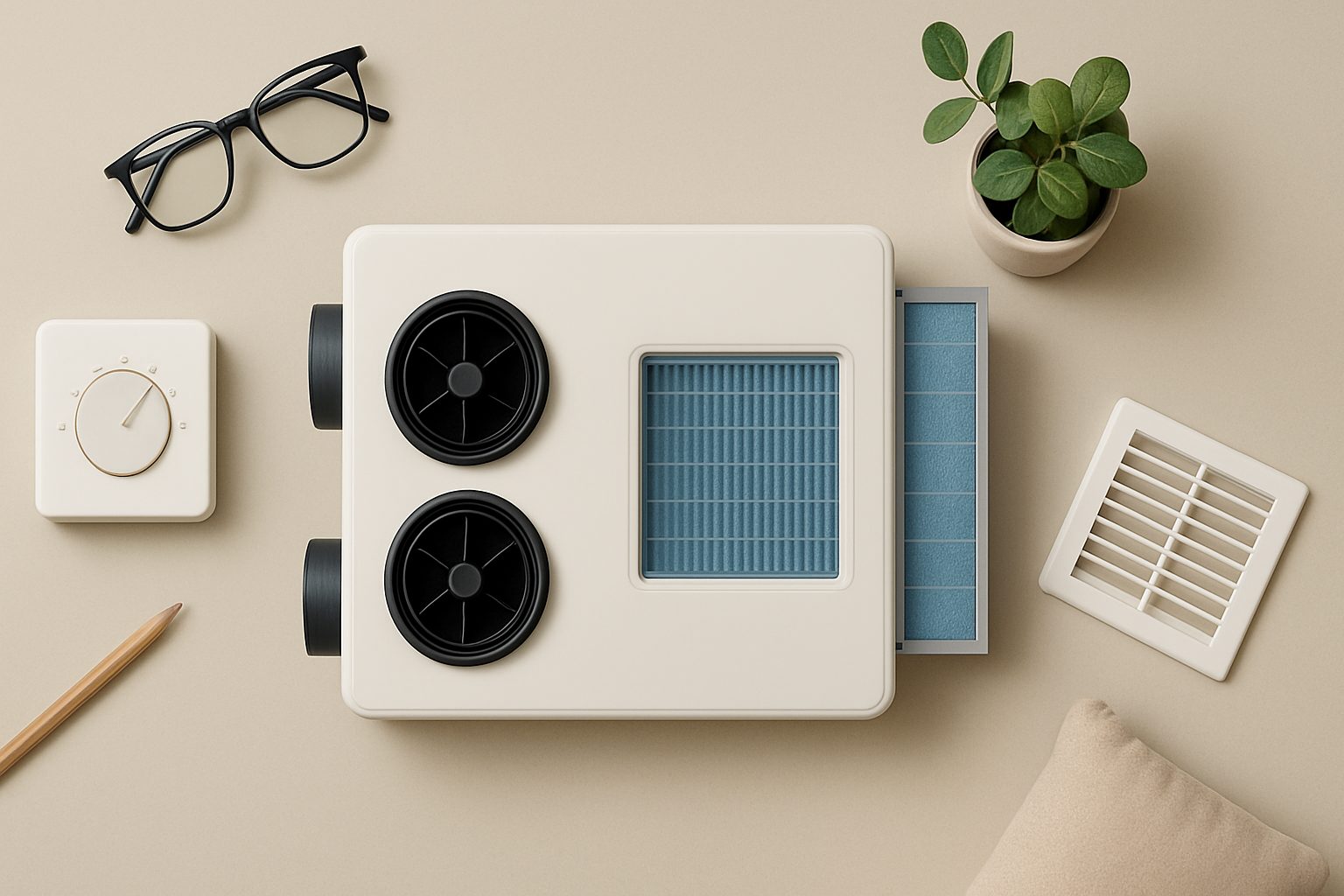
Best MVHR Units for UK New-Build Homes: 2025 Reviews & Ratings
Building regulations for new homes in the UK now effectively demand mechanical ventilation with heat recovery. If you're self-building or developing, you need to choose an MVHR unit that won't leak energy, won't need replacing in five years, and won't drive your mechanical and electrical contractors to despair during commissioning.
The three units below represent the bulk of serious new-build installations in the UK market. They're not the cheapest options, but they're the ones that actually deliver on efficiency and reliability when the building inspector calls.
Zehnder ComfoAir Q600 ER
Zehnder's Swiss engineering shows in every detail. The ComfoAir Q600 ER is a single-duct MVHR unit with a claimed heat recovery efficiency of 84%, and that figure is credible—it's based on honest EN testing, not marketing lab conditions. The unit is compact (good news if your plant room is a cupboard), extraordinarily quiet (28 dB at standard speed), and the ceramic heat exchanger is genuinely robust.
Why it works for new builds: Installation is straightforward if you brief your M&E contractor properly. The unit accepts 150 mm ducts, common enough that you won't get stuck hunting for parts. Noise is a real advantage on site—residents notice noise within weeks; they rarely complain about efficiency.
Drawbacks: First-cost premium is real. You're looking at roughly £3,000–£3,500 for the unit alone, plus ductwork and commissioning labour. The demand for proprietary replacement filters (£80 per year) locks you into servicing costs. Warranty support in the UK is good but distributed—not everyone has a local Zehnder engineer.
Best for: Builders targeting the quality end of the market, where occupants will maintain the system properly. Developer-spec projects where upfront cost is acceptable and commissioning support is available.
Vent-Axia Sentinel Kinetic
This is the UK system, made by a company that's been in ventilation for forty years. The Sentinel Kinetic comes in two configurations; the single-duct model is what most new builds use. Efficiency is rated at 84%, matching Zehnder, and the unit runs at 32 dB—slightly noisier but still imperceptible in most rooms.
Why it works for new builds: Vent-Axia has genuine UK distribution. Spares arrive next day, engineers are available across England and Scotland. The system uses standard 150 mm ducting. Build quality is no-nonsense; you're not paying for boutique marketing. Replacement filters cost less (around £50–£60).
Drawbacks: Slightly larger footprint than Zehnder; some plant rooms present a tight squeeze. The control unit is separate from the main unit, adding a wall-mounted box that some clients find visually intrusive. Heat exchanger is aluminium, not ceramic, which means it's more sensitive to acidic condensate—though in normal UK conditions this isn't a practical problem.
Best for: Developers building volume, where supply-chain reliability and fast parts availability matter more than shaving 10 dB from noise levels. Regional builders with established trade relationships.
Mitsubishi Lossnay Core 150
Lossnay is Japanese design filtered through European manufacturing. The Core 150 is unassuming—no marketing flourish—but the paper-based heat exchanger is clever. It recovers latent (moisture) energy as well as sensible heat, pushing effective efficiency toward 86% in normal UK conditions. Running noise is 29 dB.
Why it works for new builds: The paper heat exchanger performs counterintuitively well in humid climates. If you've got a wet-building (new timber, fresh plaster), the system actively helps manage moisture during the first two years—a genuine advantage over ceramic alternatives. Unit cost is competitive with Zehnder. Installation is standard.
Drawbacks: The Lossnay brand is less known in the UK self-build market; some M&E contractors are less familiar with the variant ducting diameters (also 150 mm, but connection details differ slightly). Spare parts availability is adequate but slower than Vent-Axia. The paper media needs replacing every 3–5 years if the system pulls heavy dust loads—though in UK homes with decent prefiltering, that's rare.
Best for: Self-builders and smaller developers with experienced M&E consultants. Projects where moisture control during construction matters (ground-source heat pump homes, for instance, or builds in damp valleys).
Which Unit Should You Buy?
All three units will pass Building Control. The choice is genuinely about your project constraints and risk tolerance:
- Zehnder if cost is secondary, silence is valued, and you have commissioning support lined up.
- Vent-Axia if you're building multiple units and need spare-parts certainty and fast local service.
- Lossnay if you're self-building and want genuinely reliable performance at competitive cost, with the bonus of latent-heat recovery.
Price all three installed—unit cost plus approved installer labour, controls, and first-year commissioning. You'll typically see £4,000–£6,000 difference between cheapest and most expensive, spread across a project that costs £300,000+. Don't choose on unit cost alone.
Decide now. MVHR units are lead-time items; your contractor needs 8–12 weeks' notice to order, and your commissioning engineer books up by March. Ring three installers this week for quotes. Confirm the unit once you've got a site plan and duct routes signed off. Installing an MVHR late, or retrofitting because you delayed, costs far more than the few hundred pounds you'll save by cutting corners.
More options
- Zehnder ComfoAir MVHR Units (Amazon UK)
- Vent-Axia Sentinel Kinetic MVHR (Amazon UK)
- Mitsubishi Lossnay Ventilation Units (Amazon UK)
- Nuaire Drimaster & Positive Input Ventilation (Amazon UK)
- AHU Replacement Filters & Accessories (Amazon UK)