Air Handling Units vs Standalone HVAC Systems: Which Suits UK Homes?
If you're researching climate control options for a UK home, you've probably encountered the term "air handling unit" alongside mentions of split systems, heat pumps, and fan-coil units. Understanding what these systems do—and whether they're the right fit for your property—requires clarity on how they differ fundamentally.
The confusion is understandable. An air handling unit (AHU) isn't actually a complete heating or cooling solution on its own. It's a component within a broader system. By contrast, standalone HVAC systems are self-contained units designed to deliver heating and cooling independently. Knowing this distinction helps you evaluate what's genuinely practical for your home.
What an Air Handling Unit Actually Does
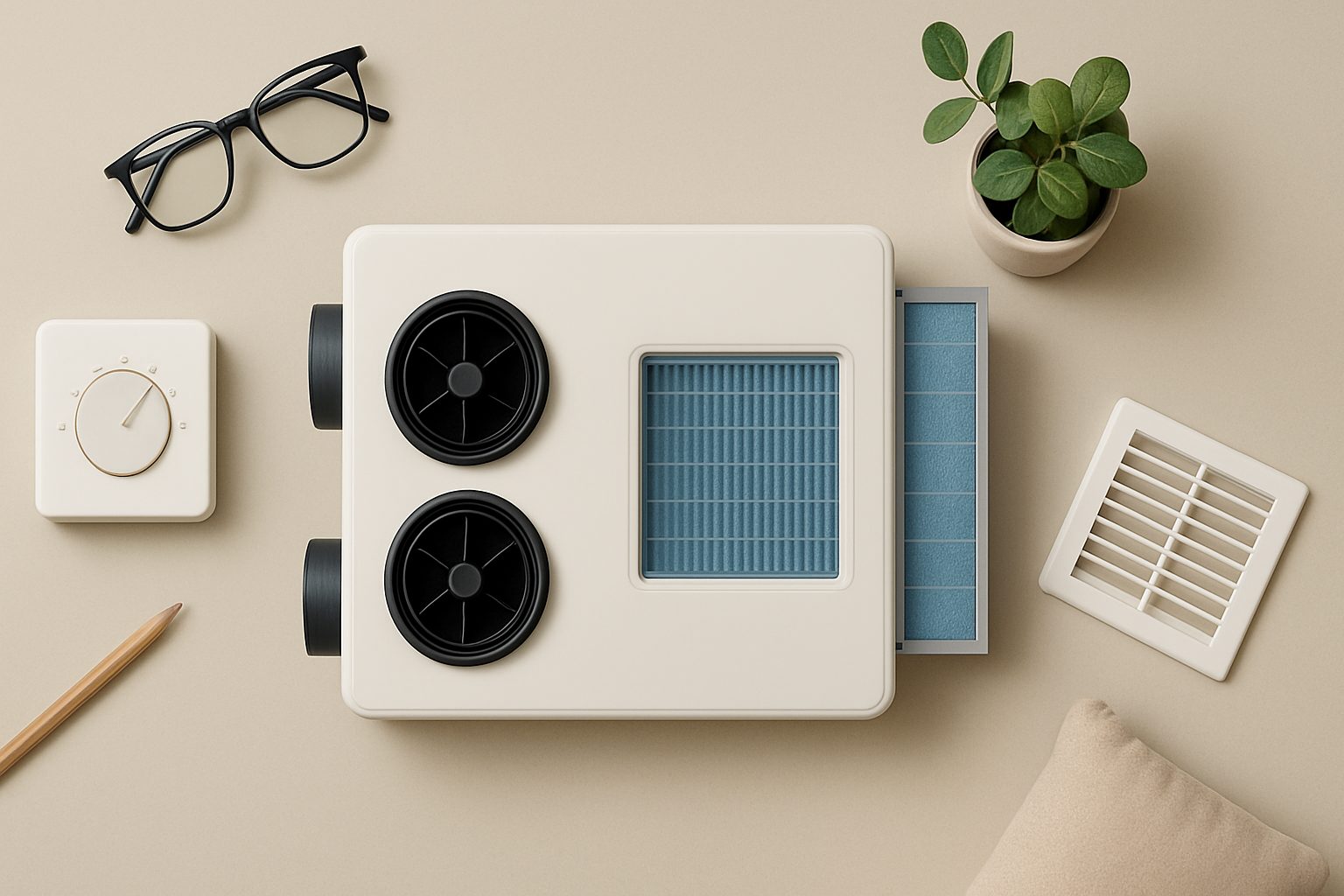
An AHU is a centralised box that conditions and distributes air throughout a building. Inside it, you'll find a fan, filters, heating coils, cooling coils, and controls. Air gets pulled in, filtered, heated or cooled depending on demand, then pushed through ductwork to rooms via vents.
The key point: an AHU requires external equipment to function. It needs a boiler for heating, a chiller or heat pump for cooling, and ductwork connecting it to your rooms. This makes it part of a system, not a standalone unit.
In UK homes, AHUs are genuinely common in new-build properties with underfloor heating or mechanical ventilation requirements. They're less common in older terraces, semis, and detached houses where retrofitting ductwork is disruptive and expensive.
Standalone HVAC Systems Explained
Standalone systems come in several flavours, each independent and relatively simple to install:
Split-system air conditioning (indoor wall unit connected to an outdoor condenser via a small pipe) provides cooling only. Popular in UK offices and new builds, rarely found in homes until recently because cooling demand was seen as unnecessary. That's changing as summers warm.
Fan-coil units are smaller, less powerful cousins of AHUs. They connect to a central hot/cold water loop but don't require extensive ductwork—they sit in a corner or under a window and push conditioned air into a room. Common in hotels and larger commercial buildings; occasionally used in UK homes with hydronic heating systems.
Heat pumps (air-source or ground-source) are increasingly popular in UK homes. They extract warmth from outside air or ground and use it for heating; newer models reverse this to provide cooling. They're standalone in the sense that a single unit can handle both functions without complex ductwork.
Hybrid systems combine a boiler with split-system cooling, giving you conventional heating and independent cooling. Growing in popularity as UK summers lengthen.
Ductwork: The Hidden Complexity
The biggest practical difference lies in installation. An AHU demands ductwork—metal or flexible pipes running through your home to distribute conditioned air. Retrofitting ducts into an existing UK home is expensive, often requiring ceiling voids, attic access, or creative routing. New builds integrate this during construction, making AHUs cost-effective at that stage.
Standalone systems sidestep this. A split-system unit needs only a small pipe chase to the outdoor condenser. A heat pump needs minimal modifications. A fan-coil unit might sit where a radiator once was.
Which System Suits UK Homes?
If your home is being newly built or undergoing major renovation with new mechanical ventilation required, an AHU is worth considering seriously. It handles heating, cooling, and ventilation in one integrated package. You'll need excellent insulation and airtightness for it to work efficiently, both increasingly standard in new builds meeting Building Regulations.
If your existing home needs cooling without major disruption, a split-system or modern heat pump is far more practical. Split systems are straightforward for cooling; heat pumps handle both heating and cooling and can replace or supplement your existing boiler, though the financial case depends on your energy tariff.
If you want heating and cooling but can't stomach ductwork disruption, a heat pump (particularly air-source, which is easier to install than ground-source) offers the most flexibility. Ground-source heat pumps require significant outdoor space and ground work—not feasible in many UK properties—but deliver higher efficiency if conditions allow.
If your home has existing hydronic heating (a water-based system), adding fan-coil units is sometimes sensible, though you'd lose the efficiency of underfloor distribution without careful design.
Operating Costs and Efficiency
AHUs can be extremely efficient in new builds where they're part of a heat-recovery system—capturing warmth from exhaust air. In retrofit scenarios, their efficiency often disappoints because ductwork leaks, poor insulation renders them uneconomical, and the capital cost of installation rarely pays back.
Heat pumps are efficient but consume electricity, making them most economical where your electricity rate is low relative to gas. A Coefficient of Performance (COP) of 3 or 4 is realistic for modern air-source units; ground-source can reach 4 to 5. Do the maths with your own tariffs before committing.
Split systems are straightforward: they're efficient at cooling but do nothing for heating. Running them alongside a gas boiler during cooling season adds a small energy bill but might be acceptable if you only need cooling three months yearly.
The Practical Reality for UK Homes
Most existing UK homes aren't suitable for AHUs. The disruption and cost don't justify the benefits when heat pumps or hybrid systems achieve similar results more pragmatically.
New-build homes or those undergoing deep renovation can make a strong case for AHUs, particularly if airtightness targets and Building Regulations demand mechanical ventilation anyway.
For retrofit climate control—the majority scenario in the UK—a heat pump or split-system AC remains the path of least disruption and most realistic ROI.
The key is matching the system to your home's construction stage, insulation standard, available space, and budget constraints. Each has genuine strengths; none is universally right for "UK homes" as a category.
More options
- Zehnder ComfoAir MVHR Units (Amazon UK)
- Vent-Axia Sentinel Kinetic MVHR (Amazon UK)
- Mitsubishi Lossnay Ventilation Units (Amazon UK)
- Nuaire Drimaster & Positive Input Ventilation (Amazon UK)
- AHU Replacement Filters & Accessories (Amazon UK)