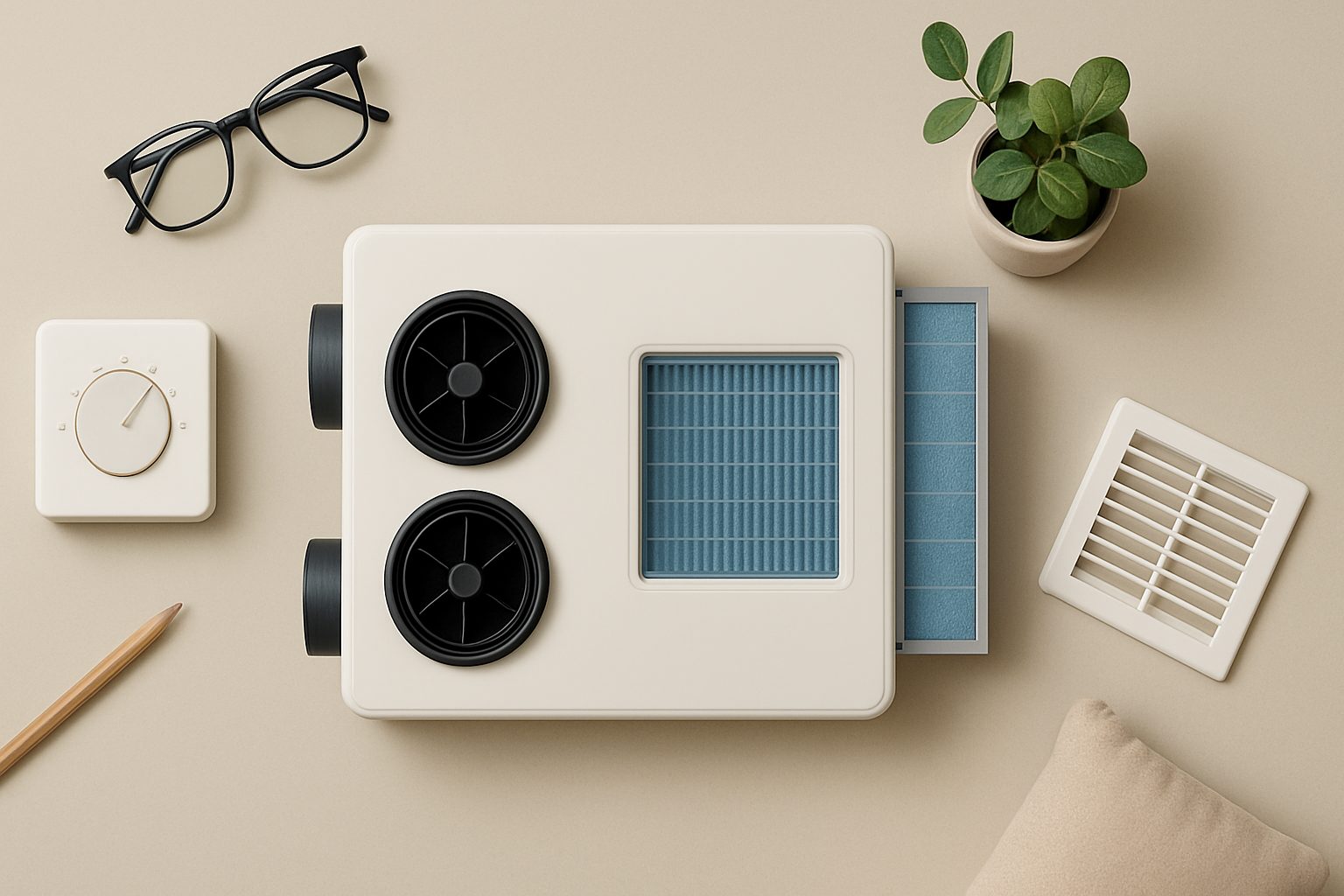
Choosing an Air Handling Unit for a UK Self-Build: Complete Guide
If you're building a new home from scratch, an air handling unit (AHU) is one of the least visible but most important decisions you'll make. A good AHU protects your health, controls moisture, and keeps energy bills sensible. A poor choice or late specification will cost you money and stress during construction. Here's what you need to know.
Why Self-Builders Need AHUs
Modern UK Building Regulations (Part L) require new homes to be far more airtight than older properties. This is excellent for energy efficiency, but it creates a problem: stale, humid air gets trapped inside. An AHU solves this by mechanically extracting stale air from kitchens, bathrooms, and utility spaces while supplying fresh air to living areas. Many come with heat recovery, capturing 70–90% of the warmth from outgoing air and adding it back to incoming fresh air.
Without proper ventilation, you'll face condensation, mould on walls and windows, and poor indoor air quality. With a badly specified system, you'll pay for electricity costs you didn't budget for or end up with noise complaints from neighbours.
Building Regulations Compliance
Your AHU must meet Part L and Part F of the Building Regulations. Part F covers ventilation rates (measured in litres per second), and Part L covers energy efficiency, including seasonal efficiency and specific fan power.
For a typical 3-bedroom detached self-build, you'll need ventilation rates around 70–100 l/s during normal operation. Building Control will want to see calculations based on room volume and occupancy. Most AHU manufacturers provide certified performance data that your M&E engineer can use in their calculations.
A heat recovery unit (MVHR system) is now standard practice for self-builds because it significantly reduces the energy penalty of introducing fresh air. You'll need to commission the system properly and retain documentation proving it meets the required efficiency standards. Many self-builders discover too late that their chosen unit won't pass Building Control inspection—so confirm compliance early with your building control officer.
Sizing the Right Unit
AHU sizing is not guesswork. It depends on your building's cubic volume, number of occupants, and kitchen/bathroom extract rates. Oversizing wastes energy and creates noise. Undersizing leaves you with poor air quality and condensation.
Your M&E engineer will calculate exact requirements, but as a rough starting point, domestic AHUs for self-builds range from 200 to 400 m³/h (cubic metres per hour). Compact units mount in loft spaces or plant rooms; larger commercial-style units are overkill for most homes.
Check the unit's noise rating (measured in decibels) before you commit. Well-designed domestic AHUs run at 30–35 dB on low speed—quieter than a refrigerator. Cheap units can exceed 40 dB, which becomes noticeable and intrusive.
Procurement Timeline
This is where many self-builders trip up. AHUs are not off-the-shelf bathroom extractor fans. Lead times are typically 8–12 weeks from order to delivery, longer if you need custom ducting or filters. Some specialist units are 16 weeks out.
Specify your AHU before you start construction, not halfway through. Your architect or M&E designer should request drawings and performance data during the design phase. Order it as soon as Building Control approves your plans. Waiting until the roof's on and you're ready for commissioning will either force you to use whatever's available (rarely ideal) or delay handover.
Check availability with suppliers directly—stock levels vary, and import delays from mainland Europe still affect delivery. Budget for this in your project timeline.
M&E Coordination
Your mechanical and electrical engineer needs to see the AHU specification early. They'll need to design ductwork routes, calculate static pressure drop, and plan for a dedicated electrical circuit (typically 10 amp single-phase for domestic units). The unit itself isn't expensive, but poor ductwork design—undersized pipes, too many bends, inadequate sealing—wastes energy and creates noise.
Ductwork must be rigid or semi-rigid, not cheap flexible ducting throughout. Flexible pipe is useful for the final connection to wall terminals, but the main runs should be properly insulated and supported. Badly installed ducts cost you heat loss and performance.
Coordinate with your electrician to ensure the control wiring is installed during the first fix. Many AHUs need a simple on/off switch and a humidity sensor or thermostat, but some builders forget this until the final stage, creating last-minute chasing-out work.
Practical Installation Considerations
Ducting needs space—lots of it. A properly designed AHU system needs routes from the unit to extract points in kitchens and bathrooms, and separate routes to supply air to living areas. Most self-builds house the unit in a loft space or a compact plant room, but you'll need ceiling or wall space for distribution ducts.
Plan for access to the unit for filter changes (typically every 3–6 months for the pre-filter, annually for the main filter). A cramped loft installation makes servicing miserable and expensive.
Soundproofing matters. Even a quiet AHU needs acoustic lining on ducting near occupied rooms to prevent fan noise carrying into bedrooms or living spaces.
Running Costs and Efficiency
A modern AHU with heat recovery costs roughly £1–2 per day to run in heating season, less in summer. Older non-recovery extract fans cost similar amounts for worse air quality. The payback comes through reduced heating bills (heat recovery typically saves 15–20% of space heating energy) and better health.
Check the AHU's seasonal efficiency rating (ηs) on the product data. Units rated ηs ≥ 80% meet current Building Regulations. Anything below 75% will struggle to pass certification.
Common Mistakes
Leaving AHU specification until late disrupts M&E planning and creates delays. Not budgeting for proper ductwork and acoustic treatment leads to expensive retrofits. Choosing a unit based on price alone without checking noise levels or Building Regulations compliance creates problems during commissioning.
Next Steps
Start by speaking with your M&E engineer about ventilation requirements. Ask for a comparison of 2–3 units from established manufacturers (Zehnder, Daikin, Aldes, and Nuaire are reliable UK suppliers). Request noise data, lead times, and Building Regulations certification. Get a detailed quote for ductwork installation, not just the unit cost.
Order early. Commission properly. Keep all documentation for Building Control and for your warranty records.
More options
- Zehnder ComfoAir MVHR Units (Amazon UK)
- Vent-Axia Sentinel Kinetic MVHR (Amazon UK)
- Mitsubishi Lossnay Ventilation Units (Amazon UK)
- Nuaire Drimaster & Positive Input Ventilation (Amazon UK)
- AHU Replacement Filters & Accessories (Amazon UK)